There are a lot of clinics offering hair treatments. Most of them are general aesthetics practices that have added a hair loss option to their menu alongside injectables, skin treatments, and everything else. This clinic does one thing. Here is why that matters — and what it means for you in practice.
Nurse-led, clinically accountable
Harrogate Hair Restoration is run by Pete Dakin, an NMC Registered Nurse with a background in patient-facing clinical care. That registration matters in a field where the barrier to entry is low and the terminology used to describe treatments is often indistinguishable from marketing.
NMC registration means professional accountability. There is a regulatory body, a code of conduct, and a mechanism for raising concerns — none of which exist for unregistered practitioners. It means the person carrying out your treatment has been trained to assess, to recognise when something is outside their scope, and to act in your best interests rather than simply upsell you.
Hair loss sits at an uncomfortable intersection of aesthetics and clinical medicine. The cosmetic treatments we offer are appropriate for a nurse-led model. The clinical ones — prescribing, diagnostics, PRP — will follow once the necessary regulatory registration is in place. That phased approach is a deliberate choice, not a shortcut.
You will be assessed by someone with clinical training, not a sales consultation. If something you ask about is outside the current scope of what we offer, you will be told clearly — and, where appropriate, pointed towards the right next step.
The Harrogate Scalp Wellness Score™
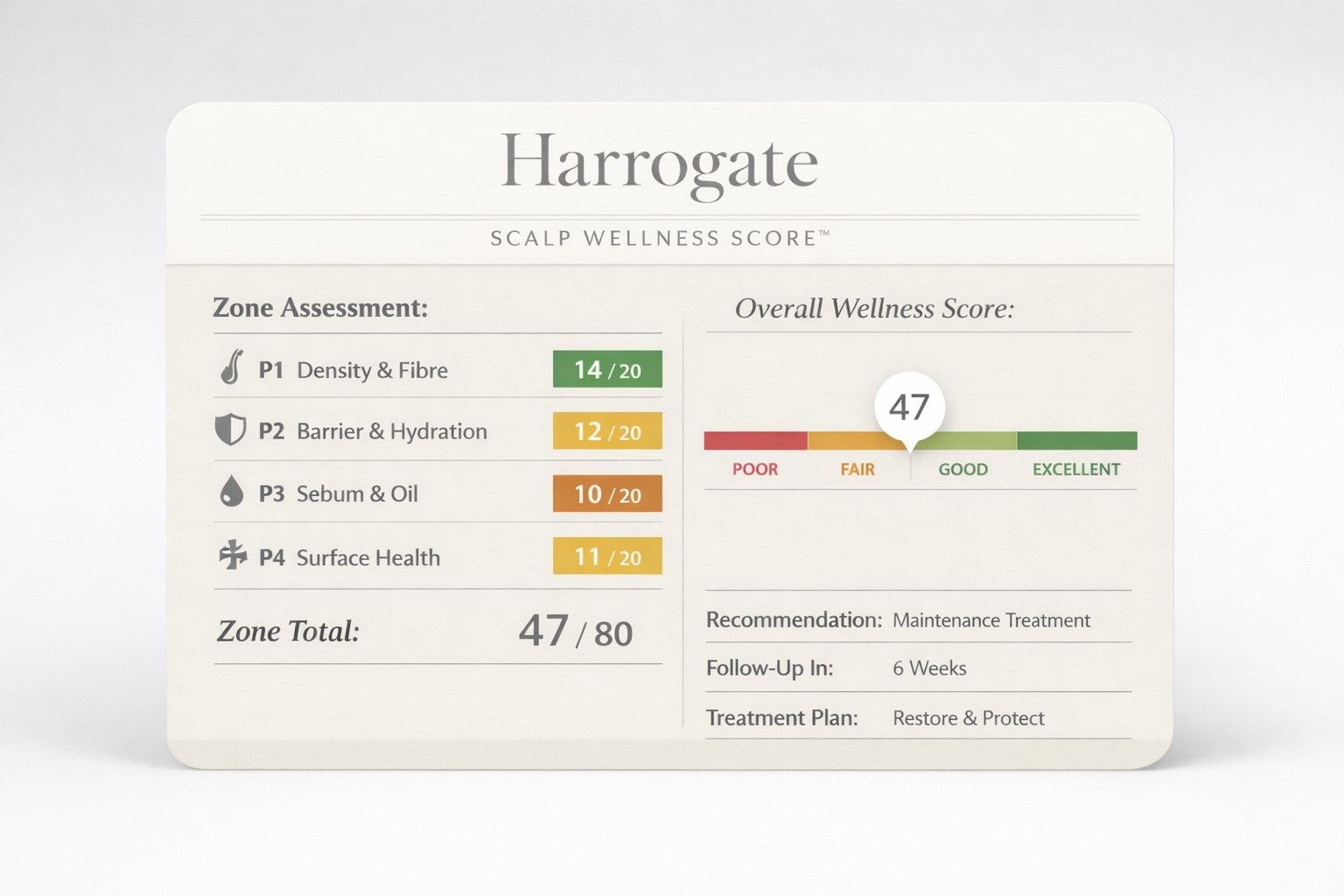
Before any treatment begins, every client receives a Cosmetic Scalp Analysis. This uses professional trichoscopy — a magnified examination of the scalp — to assess four pillars of scalp health across three zones: hair density and fibre quality, barrier and hydration, sebum and oil balance, and scalp surface condition.
The result is a Harrogate Scalp Wellness Score™ — a number out of 80 that gives an objective, repeatable baseline. It is not a diagnosis. It is a structured way of recording what the scalp looks like before treatment begins, so that any change over time can be measured rather than estimated.
Most clinics rely on before-and-after photographs alone. Photographs are useful, but they depend on lighting, angle, and how the hair is sitting on a given day. The Harrogate Scalp Wellness Score™ is an additional layer of objectivity — a scored framework that records the same parameters each time, using the same methodology, regardless of how the scalp photographs on that particular visit.
Your progress is tracked numerically, not just photographically. At weeks 1, 6, and 12 of any programme, your score is reviewed alongside photography — giving you a clear, documented picture of how your scalp has responded to treatment.
Evidence-backed treatments — named, not vague
Every active ingredient used at Harrogate Hair Restoration is chosen because there is published research behind it — and every product is named on this website. There are no vague references to "growth factors" or "stem cell technology" without specifying what those terms actually mean in this context.
Our microneedling tiers use four specific actives, each selected for a different reason.
RRS® XL Hair is a sterile, CE-marked Class III professional mesotherapy solution — non-cross-linked hyaluronic acid, 17 amino acids, 9 trace elements, 7 vitamins, antioxidants and botanicals. Non-animal origin. It is formulated to support scalp hydration, condition and microenvironment — not positioned around hair growth, but around creating the healthiest possible environment for existing follicles. A good fit for clients already managing hair loss medically who want topical scalp support alongside their routine.
A multi-active transdermal formula containing Fenugreek, Capixyl, Saw Palmetto, Azelaic Acid, Pyridoxine and Zinc — designed for microneedling delivery, formulated to support the scalp environment and the appearance of fuller-looking hair. The manufacturer's protocol is a course of 8 sessions, spaced at least 7 days apart, with the cycle repeated approximately every 6 months.
Calecim® PTT-6® is a conditioned-media complex derived from red deer umbilical cord lining stem cells, rich in growth factors and proteins, used to support the scalp environment around the follicle. For clients who prefer an animal-free option: Inbiohair® — a plant-derived, vegan, cruelty-free biomimetic peptide and growth-factor complex with over 50 active ingredients, occupying the same tier position. The supporting data for both is the manufacturer's own rather than independent trial evidence, and we would rather tell you that than quote you a number.
Purasomes® HSC50+ is a bovine colostrum-derived exosome complex containing 20 billion exosomes and 20 growth factors. For clients who prefer an animal-free option: ASCE+ HRLV® — exosomes isolated from Rosa Damascena (damask rose) callus, vegan, cruelty-free, paraben-free, steroid-free and hypoallergenic. Both are the most concentrated active we offer, dosed to three sessions across six weeks. The supporting data is the manufacturer's own rather than independent trial evidence.
Low-level laser therapy is one of the most extensively researched non-surgical options for supporting scalp health, with evidence stretching back decades. We use a professional in-clinic canopy device rather than a hand-held consumer unit, delivering consistent, calibrated energy to the full scalp in a single session.
Follow-up that means something
The Harrogate Scalp Wellness Score™ is taken before any treatment begins. That baseline is the reference point for everything that follows. For clients on the Harrogate Density Programme™, formal reviews take place at weeks 6 and 12 — the score is re-recorded, photography is compared, and the programme is assessed against where the client started.
For clients completing a standalone course of treatment — whether microneedling, LLLT, or hydradermabrasion — a follow-up review is offered once the course is complete. This is not a sales appointment. It is an honest assessment of how the scalp has responded, what the score looks like compared to the baseline, and what, if anything, would be appropriate next.
That might mean a maintenance programme. It might mean a different treatment. It might mean nothing further is needed for a period of time. The point is that the decision is informed — by objective data, not by a practitioner with a reason to keep you booking.
You are not left to decide alone whether treatment is working. The scoring framework, the photography, and the follow-up review give you an objective basis for any decision about continuing, adjusting, or pausing your scalp care plan.