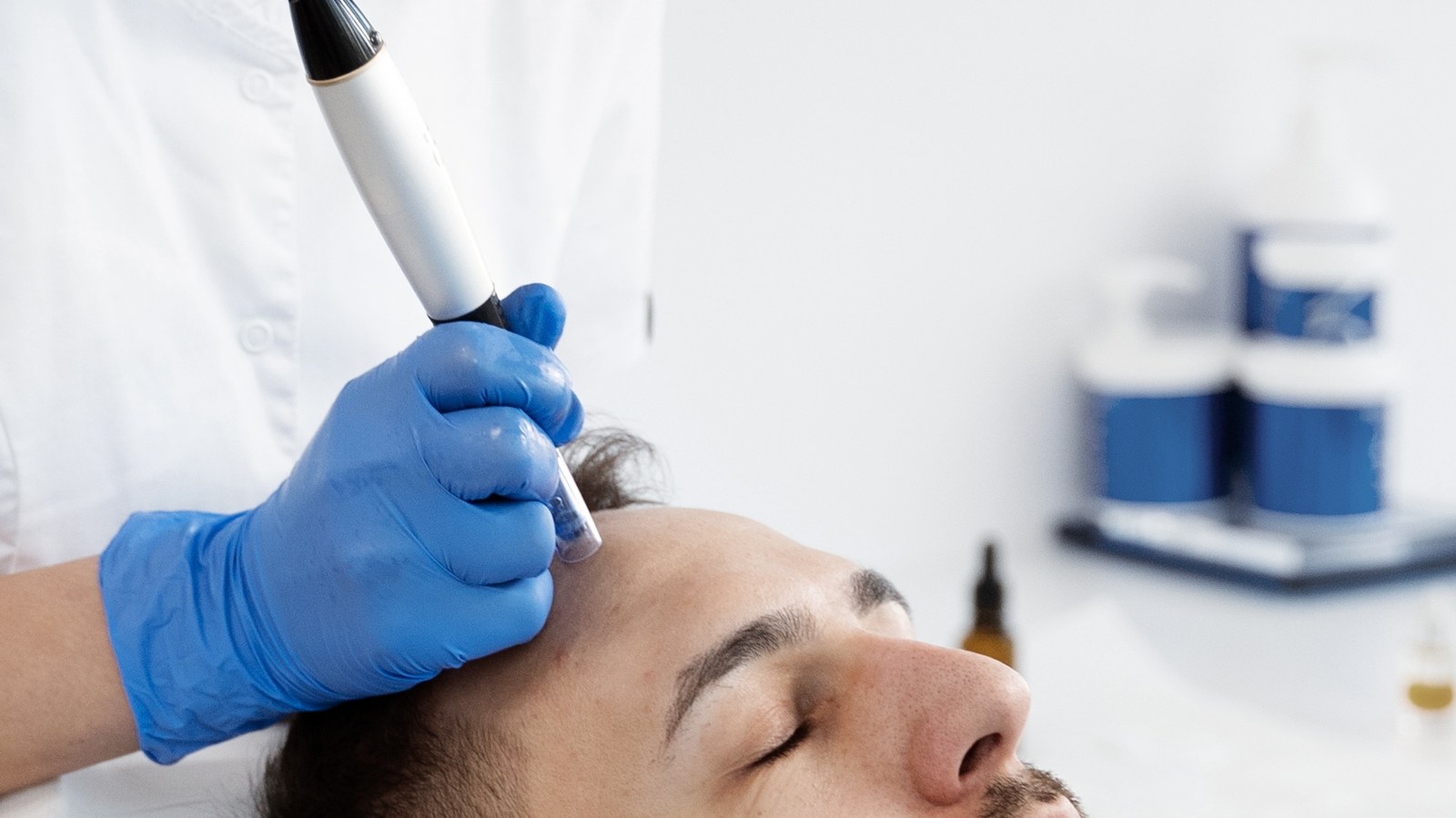
If you've looked into anything for thinning hair, you've almost certainly come across microneedling. And if you're anything like the men I see day to day, your first thought was probably some version of: is this actually a real thing, or just another gimmick with a nice name? It's a fair question — so here's my honest answer, without the jargon.
What it actually is
Microneedling is exactly what it sounds like — a device with very fine needles that creates tiny, controlled channels in the scalp. Two things happen when you do that. First, the scalp responds to those micro-channels by ramping up its own natural repair signals — the same growth factors your skin already uses to heal itself. Second, anything applied to the scalp afterwards absorbs far better than it would through unbroken skin.
So it's doing two jobs at once: waking the scalp up, and helping whatever you put on it actually get where it needs to go.
Does it actually work?
This is where I can be genuinely reassuring, because microneedling isn't one of those things propped up by a single dodgy study and a lot of marketing. It's been through proper research — including randomised controlled trials, which are the gold standard, and several independent reviews that pull all of those trials together.
The picture that comes out is consistent: in the studies, microneedling has a real, measurable effect. It's not magic, it won't turn back the clock, and the researchers themselves are the first to say that bigger and longer trials would make the case stronger still. But as things stand, this is a technique with genuine evidence behind it — not a fad.
Why it has to be done properly
Here's the part that matters most, and the reason I'm careful about it. The evidence is for microneedling done properly — the right depth, clean technique, a considered approach. That is not the same as buying a cheap roller online and going at your own scalp in the bathroom mirror. Done badly, at best you get nothing; at worst you risk irritation, infection, or damage to the very follicles you're trying to look after.
The needles are the easy part. Knowing how deep, how often, and what to pair it with is the actual skill — and it's why this belongs in a clinic rather than a shopping basket.
The honest bit
You'll get honesty from me every time, so here it is. The strongest studies tend to pair microneedling with a medical treatment — usually topical minoxidil. That combination is where the biggest results come from. My clinic today is a cosmetic scalp and hair wellness service, so the medical, prescription side of things is part of where we're heading next as our registration progresses — it isn't what we offer right now.
What that means in plain terms: the evidence for microneedling as a technique is strong, and I'll always stand behind that. The evidence for exactly which active you layer on top is more mixed and more product-specific, and I'm not going to pretend otherwise or dress up a manufacturer's brochure as proof.
When I recommend something, it's because I've read the independent evidence myself and I'm comfortable with it. And when the honest answer is "this is promising but not yet proven," I'll tell you that too.
If you're already using minoxidil
There's one group I can be especially straightforward with: men already using topical minoxidil.
If you already apply minoxidil as part of your own routine — something you source and use independently — then microneedling isn't me asking you to believe in a new product. It's the exact intervention those studies added on top of minoxidil to get their results. So a simple once-a-month microneedling session alongside your existing minoxidil is about as honest and evidence-backed as anything I can offer. You keep doing what you're doing; I add the piece the research actually tested.
If your minoxidil is the tablet rather than the liquid or foam, this is a different picture. The trials all used topical minoxidil, and a large part of why microneedling helps is that it improves how well that topical is absorbed into the scalp — which simply doesn't apply to a tablet already working through your system. Microneedling can still be worth considering on its own merits, but I'd be misleading you if I claimed the same evidence carries across. If you're on oral minoxidil, that's a conversation worth having in person, not a box I'd tick from a blog post.
That's the whole point of starting with a cosmetic scalp analysis: an honest look at what's actually going on, and a straight conversation about what will and won't help. If microneedling is a sensible option for you, I'll say so. If it isn't, I'll say that just as clearly.
— Pete
If you'd like to read the evidence yourself
You don't need to — that's my job. But if you're the sort who likes to check the working, here are some of the independent, peer-reviewed studies and reviews I've drawn on. They're all freely available:
- Pei et al. (2024), Journal of Cosmetic Dermatology — a systematic review and meta-analysis pooling 13 randomised controlled trials (696 patients), finding combined microneedling improved hair density and diameter with good safety.
- A systematic review and meta-analysis of 12 randomised controlled trials (631 patients), finding microneedling combined with topical minoxidil improved hair count over minoxidil alone.
- Adistri et al. (2024), Dermatology Reports — a randomised controlled trial in men comparing microneedling plus 5% topical minoxidil against minoxidil alone over 12 weeks.
- A 2022 review in Aesthetic Plastic Surgery — a broad summary of the clinical trial evidence which, honestly, also calls for larger and longer studies.
The consistent theme across all of them: microneedling is a safe and promising technique, and the research community is clear that bigger, longer trials will keep sharpening the picture. That's exactly the balance I try to strike with you in clinic — confident where the evidence is solid, straight with you where it's still growing.